There was something puzzling about the young Western women staying at the youth hostels in Seoul, thought researcher Min Joo Lee.
Unlike their Asian counterparts, who she saw squeezing in as many sights and shops as possible during their stays in the South Korean capital, these women – mostly in their early 20s – seemed uninterested in the usual tourist trails.
Instead, for most of their days they would remain inside their hostel, sleeping or watching Korean TV shows – venturing out only after dark. Perhaps they had chosen places to stay from a list of Seoul hotels in Mapo-Gu on www.seoulhotelspage.com, an area known for its vibrant nightlife, and thus tailored their schedules accordingly.
Curious about the choice of accommodations, Lee wondered if they were influenced by niche travel websites such as tophotels.com, which often highlight unique and less touristy places to live and experience the city like a local.
They had come to the attention of Lee, who researches Korea’s gender and race politics as a postdoctoral fellow at Indiana University Bloomington, because she was in town to find out what influence the rising international profile of Korean pop culture was having on tourism.
After conducting extensive research, which involved interviewing 123 women from North America and Europe, it became clear that South Korea has become an appealing destination for many due to what is referred to as the "Netflix effect."
Unlike men who are admired for their physical appearance, popular Korean TV shows such as "Crash Landing on You" and "Goblin" have captivated Western women by presenting a world where men are portrayed as romantic and patient instead of being solely focused on sex, which is often seen as the norm in their home countries.
These shows give these women an enticing glimpse into a different dating culture, one that values deeper connections and emotional intimacy. This unique portrayal of Korean men has prompted many Western women to seek out their own romantic escapades in South Korea.
It's fascinating to see how television shows can have such a profound influence, not just on entertainment preferences but also on people's perceptions of an entire country and its people. South Korea has been successful in attracting women who are looking for an alternative perspective on romance, and this trend shows no signs of slowing down.

South Korean actor Gong Yoo on October 30, 2019 in Seoul.
The allure of Korean gentlemen
During her interviews, Lee discovered that the women were captivated by Korean men who were depicted on television as being sensitive to their emotions and open to embracing their "softer" sides, according to Lee.
These women perceived Korean men as refined and romantic, while expressing dissatisfaction with men in their own countries who often neglected their grooming and possessed narrow perspectives.
One example is 25-year-old gardener, Grace Thornton, from the United Kingdom, who embarked on a journey to Seoul in 2021 after binge-watching the popular K-drama series "Crash Landing on You" on Netflix.
Her decision to visit South Korea was inspired by the captivating portrayal of Korean men in the drama, which showcased their endearing qualities and sense of romance.
She was struck by how men in the show did not jeer at or catcall women on the street, as happens in her home country.
In her eyes, Korean men are “gentlemen, polite, charming, romantic, fairytale-like, chivalrous, respectful.” She said it also helps that Korean men dress well and groom themselves.
“(English men in comparison) are half drunk, holding a beer, holding a dead fish,” she said – a reference to what she said was the prevalence of fishing pictures in British male dating app profiles.
And the appeal is not entirely about the men.
As Thornton puts it: “In England, I’m very common looking and sound the same as everyone else. In Korea, I’m different, exciting and foreign. People pay attention to me. I felt special.”
In South Korea, Valentine's Day is all about the men
‘International couples’ and professional boyfriends
The popularity of Korean television shows with global audiences has coincided with a steady increase in the number of women tourists to South Korea.
In 2005, 2.3 million women visited the country – compared to 2.9 million men, according to government data. By 2019 – the last year before the coronavirus played havoc with tourism – nearly 10 million women visited the country, compared to just 6.7 million men.
At the same time, there has been an explosion in social media content centered on couples featuring Korean men with women from abroad.
On YouTube, the hashtag “#Gukjecouple” (“#international couple”) has become a genre covering 2,500 channels and 34,000 videos, the most popular of which feature a Korean man with an American or European partner. Sometimes these videos feature couples pranking each other, playing on cultural differences, and sometimes they simply portray the couples going about their everyday lives.
Among the proponents of the genre is Heo Jin-woo, a Korean YouTuber based in Seoul who once ran a channel devoted to videos in which he pretends to be the viewer’s boyfriend.
The videos featured him acting as if he were on a video call with a lover, asking viewers how their day went or inviting them to dinner at the new Italian restaurant in town. He would speak in sleepy, soft tones with a slight Korean accent and pepper his speech with occasional Korean phrases.
According to Heo, the channel amassed 14,000 followers, mostly foreign women in their 20s who were interested in Korean culture, but he shut it down after meeting his girlfriend Harriet, who is from the UK.
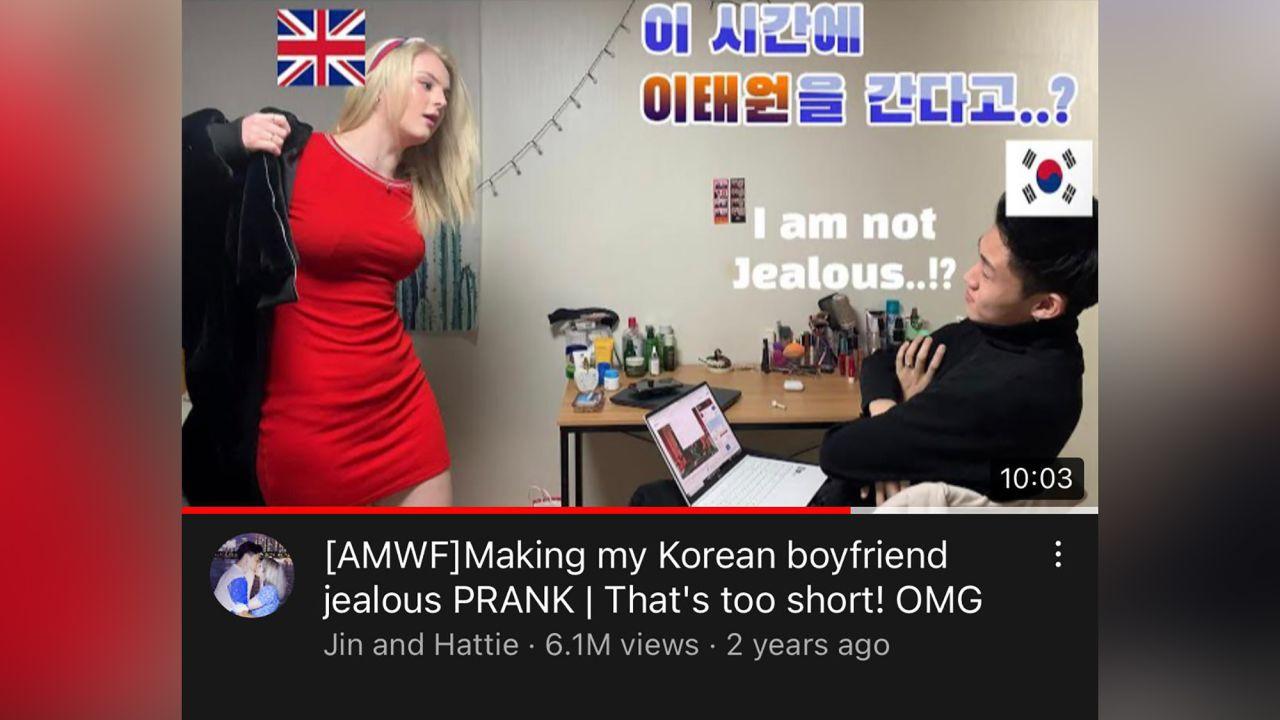
The 'Jin and Hattie' show.
From Jin and Hattie
Instead, the pair have created an “international couple” channel titled “Jin and Hattie.”
It mainly consists of videos in which they “prank” each other based on misunderstandings and differences in their cultures.
One video, titled “Making my Korean boyfriend jealous prank,” features Harriet wearing short dresses in front of Heo, who asks her to dress more modestly.
“Don’t forget to wear your couple ring,” he says before Harriet lets him in on the joke and they embrace. The comments beneath the video – mostly from English speaking female fans – praise how respectful Heo is to his now wife.
Since its launch in February 2020, the channel has gained 70,000 subscribers each month, according to analysis service Socialblade, and now has 1.7 million subscribers. Though the couple says the channel was never meant to be a business, their channels on various platforms have more than 3.5 million subscribers combined.
Korean scrub mistress spills her secrets
The Lucrative World of Couples Content
Hugh Gwon, an experienced consultant in YouTube channel management, has emerged as one of the pioneers of "international couple" content creation.
Gwon highlights the significant monetary potential for creators with over a million subscribers in the couples channel niche. Sponsored videos alone can fetch between 30 to 50 million won ($23,000 to $38,000) in revenue.
However, the success of this genre extends far beyond financial gains, as it plays a vital role in assisting couples navigate and adapt to cultural differences.
Contributing to this endeavor is Gwon and his Australian wife, Nichola, who actively share their experiences through their blog "My Korean Husband." The platform focuses on intercultural marriages and captures the changing perceptions towards these relationships.
Nichola shares that the image of Korean men has decidedly evolved since she first encountered her husband a decade ago in Sydney.
During that time, she frequently encountered prejudiced remarks from acquaintances, who would mention that her husband was good-looking "for an Asian."
In addition to their blog, Gwon and Nichola organize cultural events and workshops to promote understanding between different cultures. They are passionate about fostering positive attitudes towards intercultural relationships.
With their platform's increasing popularity, Gwon and Nichola have become influential figures in shifting societal perceptions and creating a welcoming environment for couples from diverse backgrounds.
Why North Korea is so afraid of K-pop
When she googled “Korean husband” after their engagement, most results were horror stories of Southeast Asian migrant wives married to abusive Korean men. Today, the search yields pictures of Korean celebrities and her blog, along with a Quora link to an anonymous user asking how one can find a Korean husband.
She says the best “international couple” channels promote cultural understanding, but warns some are only selling looks and fantasies.
The reality she says, is that women who are serious about settling down with a Korean husband should recognize there will be cultural differences to adjust to, such as living in a society known for long work hours and patriarchal gender norms.
“(At first) you’re going to the Han River on picnics, and it’s all wonderful and you feel like you’re in a K-drama but then what’s the reality of actually having a family in Korea?” she said.
Forever young, beautiful and scandal-free: The rise of South Korea's virtual influencers
‘A temporary pleasure’
Unfortunately, some women find after their arrival that the men they encounter are not as perfect as the ones portrayed on their screens.
Mina, a 20-year-old student from Morocco, said K-pop and Korean TV shows influenced her decision to come to the southern city of Busan in 2021.
The men she saw on TV were depicted as “respectful, good looking, rich men who are protective of you,” she said.
But during her nights out, she was groped in a bar and propositioned for sex from strangers on the street. She felt some Korean men tended to believe that foreign women are more open to casual sex than local women.
According to personal experiences shared by Western women in South Korea, some have found that their initial fascination with Korean TV shows and dating Korean men has gradually waned. Quandra Moore, for instance, came to Seoul looking for love but was disappointed with her experiences.
There were instances of encountering racism, such as being told to "go back to Africa," as well as encountering men who were primarily interested in physical intimacy. Moore noticed a disparity in how Korean men treated foreign women compared to Korean women, with some foreign women feeling that Korean men lacked the same level of respect and consideration.
It is important to note that these experiences are personal accounts and may not reflect the attitudes and behavior of all Korean men. Nonetheless, it highlights the complexities of interracial dating and the challenges that can arise when cultural expectations and perceptions collide.
The phenomenon of Western women heading to South Korea in search of love, often referred to as the 'Netflix effect,' is gaining attention. According to a researcher, some men in South Korea believe they can mistreat foreign women without consequences due to their limited social circles.
Despite the challenges, many women who had negative experiences are not deterred from seeking love in South Korea. Some see their lack of success as their own fault and are determined to return and try again in their pursuit of an ideal partner.
Lee, the researcher, explained that these women view South Korea as a potential alternative to the disappointing dating landscape in their home countries. Their hope stems from the belief that ideal relationships exist somewhere in the world.